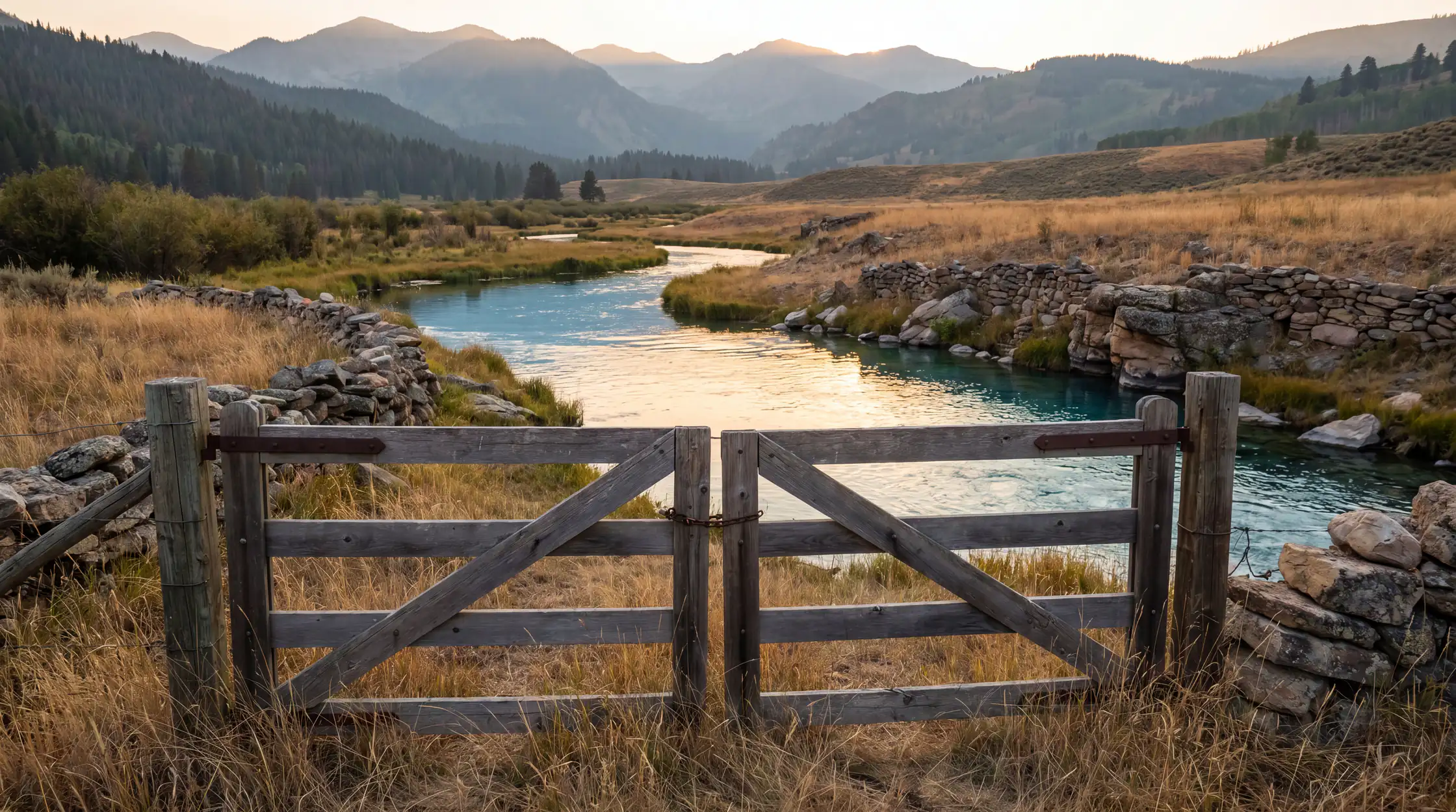
An Observation, Not a Complaint
If you have spent time studying maps of the American West, you have noticed a pattern. The public land — the national forests, the BLM tracts, the wilderness areas — tends to be high, steep, and dry. The private land tends to be low, flat, and wet. The places where trout thrive — the valley floors, the spring creeks, the fertile bottomlands where cold water meets rich substrate — are overwhelmingly in private hands.
This is not an accident, and it is not a conspiracy. It is the predictable result of 150 years of settlement patterns, federal land policy, and the basic economics of ranching in the American West. Understanding why the best water ended up behind gates is the first step toward understanding how it can be responsibly accessed.
How the Land Got Divided
The federal government owns approximately 640 million acres of land in the United States, according to the Congressional Research Service — roughly 28 percent of the nation's total land area. But that ownership is not evenly distributed. More than 90 percent of federal land is concentrated in 12 western states, where it makes up vast swaths of the landscape.
The pattern of what the federal government kept and what it gave away is the key to understanding the private water question. During the 19th century, the federal government distributed land to settlers, railroads, and states through a series of programs — the Homestead Act, railroad land grants, state land grants, and various other mechanisms. Settlers naturally claimed the land that was most valuable for agriculture and ranching: the river valleys, the irrigable bottomlands, and the areas with reliable water.
What remained in federal ownership was, broadly, the land nobody claimed because it was too high, too steep, too dry, or too remote for productive use. National forests were carved from the mountains. BLM land was what was left over — the high desert, the sagebrush flats, the rocky uplands.
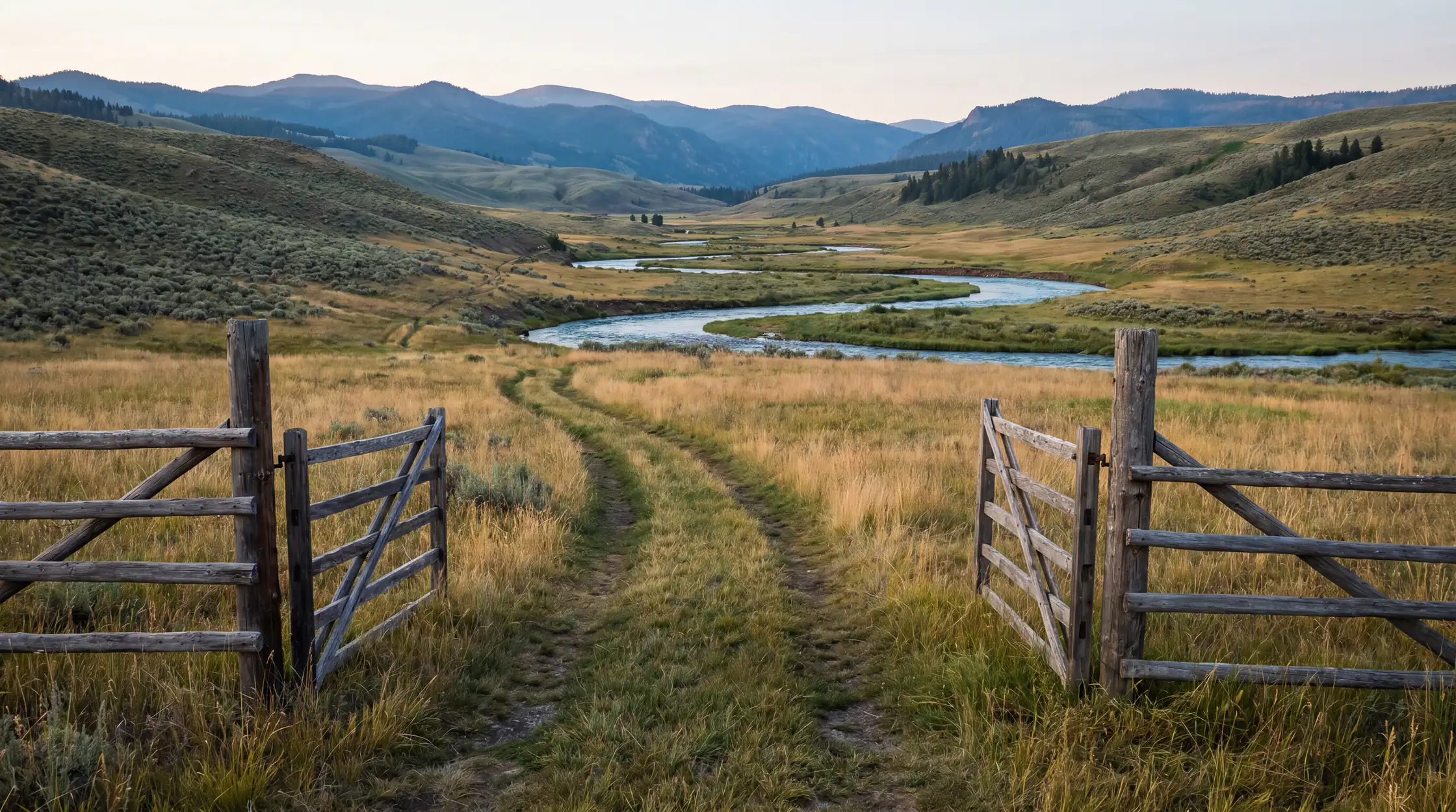
The result is a landscape where the productive lowlands are private and the scenic highlands are public. For hikers and hunters, public land offers extraordinary access. For anglers targeting trout in valley streams and spring creeks, the best habitat is often on the other side of a fence.
Water Law and the Access Patchwork
The legal framework around water access varies dramatically by state, creating a patchwork that confuses anglers and shapes the accessibility of private water.
Western states generally follow one of two legal doctrines regarding water rights. The prior appropriation doctrine, used in states like Colorado, Wyoming, Montana, and Idaho, allocates water rights based on historical claims rather than land ownership. The riparian doctrine, more common in eastern states, ties water rights to ownership of land adjacent to the waterway. Many states use a hybrid of both.
But water rights and fishing access are separate questions, and each state handles them differently.
Montana is the most permissive state for public fishing access. Under Montana law, any surface water capable of recreational use is open to the public, regardless of who owns the streambed. An angler can wade a river through a private ranch as long as they stay below the high-water mark and access the river from a public point.
Colorado sits at the opposite end of the spectrum. The public has no right to touch a privately owned streambed without the landowner's permission, regardless of the water flowing over it. An angler who wades through private property in Colorado is trespassing, full stop.
Wyoming, Idaho, Oregon, and other western states fall somewhere between these poles, each with their own rules about navigability, streambed ownership, and what constitutes legal access. The practical effect is that an angler's ability to reach productive water depends heavily on which state they are standing in.
For anglers who want to fish the best trout water in the West, this legal patchwork means that much of it requires some form of private access arrangement — a club membership, a guided trip, or a direct relationship with a landowner.
The Spring Creek Factor
Spring creeks deserve special mention because they represent some of the finest trout habitat in North America and are almost entirely on private land.
A spring creek is fed by underground aquifers rather than surface runoff. This gives it several characteristics that trout thrive on: consistent cold temperatures year-round, stable flows that resist drought and flood cycles, mineral-rich water that supports prolific insect life, and clear conditions that allow aquatic vegetation to flourish.
Spring creeks emerge where geological conditions force groundwater to the surface — and those conditions tend to occur in valley floors and lowland areas that were claimed as private ranch land generations ago. The spring creeks of Montana's Paradise Valley, the limestone creeks of central Pennsylvania, and the spring-fed streams of Idaho's eastern plains are almost all on private land because the geography that creates spring creeks is the same geography that creates productive ranch land.
These fisheries are extraordinarily productive. The trout grow large, feed selectively, and test even experienced anglers. They are also fragile — small systems that can be degraded quickly by overuse, poor land management, or uncontrolled access. The private ownership that restricts access also, in many cases, protects the habitat. Ranchers who have managed spring creeks on their property for generations often understand the resource better than anyone.
The Landlocked Lands Problem
The private-public land division creates another access challenge that compounds the fishing access question. According to research by the Theodore Roosevelt Conservation Partnership and onX, approximately 9.5 million acres of federal public land in western states are landlocked — completely surrounded by private land with no legal public access route.
These landlocked parcels often contain fishable water. A creek that runs through a BLM parcel is technically public water on public land, but if every approach crosses private property, it is effectively inaccessible without landowner permission. The legal right exists, but the practical access does not.
This reality means that even some nominally public water functions as private water in practice. The only way to reach it is through a relationship with the surrounding landowner — the same kind of relationship that clubs and platforms facilitate for explicitly private water.
Why Private Ownership Is Not the Problem
It is tempting to frame the private water situation as a problem to be solved through expanded public access mandates. But that framing misses something important: private ownership is often what keeps the best water healthy.
Ranchers and landowners who manage their land well produce fisheries that outperform comparable public water. They control livestock access to streams, maintain riparian buffers, manage flows where possible, and limit the human pressure that degrades habitat. The economic incentive of fishing access revenue reinforces this stewardship — a landowner who earns income from healthy trout water has a direct financial reason to keep it healthy.
Public water, by contrast, often suffers from the tragedy of the commons. High angling pressure, bank erosion from foot traffic, and limited enforcement of regulations all take a toll that is distributed across a resource nobody individually owns. State agencies do their best with limited budgets, but managed private water often has more resources per mile devoted to conservation than adjacent public water.
The issue is not that private water exists. It is that access to it has historically been limited to those who own land, know someone who owns land, or can afford to lease water directly.
How Structured Access Is Opening the Gates
The club model that has existed for over a century is the original solution to the private water access problem. Clubs pool resources, build landowner trust, and distribute access across a vetted membership. They work, and they have worked for a long time.
What is changing is the scale and accessibility of the model. Historically, finding and joining a fly fishing club required personal connections. You had to know someone who knew someone. Information about which clubs existed, which had openings, and which managed quality water traveled by word of mouth.
Platforms like AnglerPass make the club model discoverable. Anglers can browse clubs by region, review water portfolios, and apply for membership through the platform. Clubs can reach prospective members beyond their existing social networks. Landowners can connect with clubs without attending county fairs and hoping to meet the right person.
The cross-club access network extends this further. An angler who joins one club on AnglerPass gains the ability to book water managed by any other participating club in the network. A single membership becomes a gateway to private water across multiple states and dozens of properties.
None of this changes who owns the land. The landowner retains full control. The club continues to manage the relationship. What changes is that the pathway from interested angler to responsible private water access is shorter, more transparent, and more accessible than it has ever been.
The Future of Access
The best water in America will remain behind gates. That is a function of geography, history, and law that is not going to change. But the gates do not have to be closed.
Every landowner who partners with a club to offer structured access opens water that was previously unreachable. Every club that joins a network extends its members' reach beyond its own properties. Every angler who fishes private water responsibly — following the rules, respecting the land, supporting the stewardship — strengthens the case for more access, not less.
The private water access model works when it is built on trust between anglers, clubs, and landowners. That trust has traditionally been built slowly, through personal relationships that took years to develop. Platforms and networks are not replacing that trust. They are creating infrastructure that allows it to form faster, scale further, and sustain itself as the people involved change over time.
The best water in America is behind a gate. Increasingly, that gate has a path to it.