The Season That Exposes the System
There is a window every summer — typically late July through the second week of August in the West — where the difference between public water and well-managed private water becomes obvious. The famous rivers are still beautiful. The lodges are full. The guide shops are running daily trips. But the fishing has thinned. The fish are sitting deeper, eating less, and moving into the limited cold-water refugia. The water is shallower than it should be, warmer than it should be, and being fished by a larger number of anglers than is good for any of them.
This is not a complaint about public water. It is an honest description of what happens when you concentrate use on a finite resource during the period when the resource is least resilient. The geography is the same as it was in May. The fish are the same fish. What has changed is the relationship between what the rivers can absorb and what they are being asked to provide.
The rivers that hold up well during this window are usually the ones where someone has put limits on the relationship. Limited access. Limited daily capacity. Cold inflows that don't depend on snowpack lasting into August. Riparian shade that survived the last sixty years. This is the structural advantage of well-managed private water in mid-summer: it is built to function in the season that exposes the weaknesses of unmanaged water.
The Three Compounding Problems
Western trout fishing in late summer struggles with three problems that interact in ways that are worse than the sum of their parts.
The first is heat. Trout become physiologically stressed at water temperatures above the mid-60s and risk lethal stress as temperatures climb into the low 70s. Many of the celebrated freestone rivers run in the mid-60s by mid-July and into dangerous territory by early August in the lower stretches. Catch-and-release fishing during these temperatures has measurably higher mortality, which is why the western state agencies issue hoot-owl restrictions or full closures with increasing frequency.
The second is low flows. Summer runoff is mostly over by July. The rivers are running on whatever the watershed can still deliver, which depends on snowpack, groundwater, and the seasonal pulse from upper-basin sources. A dry winter and a hot June produce rivers that are sometimes 30 to 50 percent below historical August averages. Low flows concentrate fish into smaller holding water, which makes them easier to find but also easier to put under repeated stress.
The third is pressure. The high-season for fly fishing — July through Labor Day — is when guides are working their longest hours, when the destination travel market peaks, and when the famous tailwaters and freestones see their largest crowds. Pressure interacts badly with the first two problems. A trout that has already been caught once in a week, sitting in 65-degree water, in a low-flow holding lie, has very little margin if it gets caught again the next afternoon.
Individually, any of these problems is manageable. Together they compound. By mid-August on a typical western public-water summer, you are fishing tired fish in stressed water at the wrong time of day, and the productive window has shrunk to the four hours around sunrise.
What Private Water Holds Differently
The better managed private water in the West is structurally insulated from each of those problems.
A lot of private trout water in the West is spring-fed or sits above headwater divides. Spring creeks come out of the ground at a constant 50-something degrees year-round. Headwater meadow streams are cooler than their downstream counterparts because they are closer to the snowpack source and haven't accumulated thermal load from the lower watershed. A river that runs 70 degrees in the lower town might be running 58 in its headwater meadows. The fish in the meadow are still feeding, still hungry, and still safe to catch and release. The fish in town are not.
Daily capacity on managed private water is set by the club or landowner. A typical small private property allows two to six rods per day. That number is not driven by fashion. It is driven by what the property can sustain — what the water can absorb in terms of angling pressure, what the fish populations can handle in terms of repeated handling, and what the experience the club promises actually requires. A property managed by a serious club in late summer is fishing the same number of rods on the same number of days as it was in early June. The pressure curve is flat.
Access control means the next angler on a piece of water is known, vetted, briefed on the rules, and committed to the same conservation ethic. The trout sitting in the bank pocket on a private spring creek in mid-August has been caught once or twice this season, by anglers who landed it properly, didn't keep it out of the water, and moved on. It is in good shape. It is still willing.
The Practical Difference on the Water
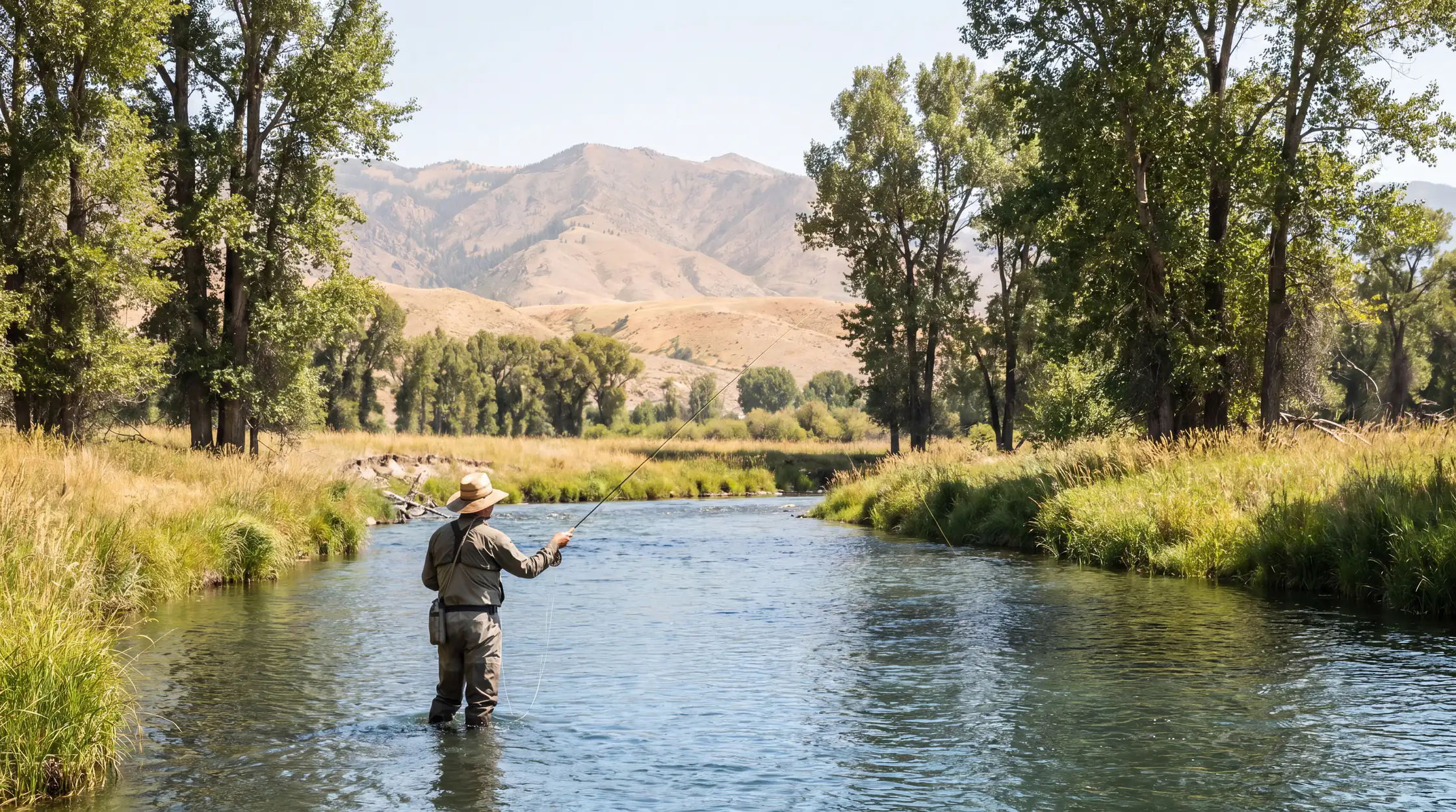
The practical experience of fishing well-managed private water in late summer is that the day looks like a different season. The flows are reasonable. The water is cool. The fish are eating. You can fish productive water in the middle of the afternoon without feeling guilty about it. The hatches that have stopped happening on the lower river are still happening on the upper meadows. The spring creeks are showing their normal mid-summer rhythm — pale morning duns in the morning, terrestrials by midday, spinner falls in the long evening.
This is not luck. It is the predictable result of a system designed to function through the hardest part of the season. The water that can take heat does take heat. The water that has limited pressure stays in shape. The fish that get a careful, managed handful of anglers in front of them across a summer remain catchable in August in a way that fish in heavily pressured public water do not.
When to Choose Which
The usefulness of private water in mid-summer is not that it replaces public water. Public rivers in the West are extraordinary resources, and the right play for many anglers in July and August is to fish them at the right times — first light in the cool morning, the evening hour after the sun is off the water — and stay off them in the middle of the day.
What private water adds during this season is a productive option for the middle of the day, for visiting anglers who are only in the region for a few days and need to fish on a schedule, and for clubs whose members would otherwise be standing in the same crowded runs as everyone else. It also takes pressure off the public stretches. Every angler fishing a managed private property in August is an angler not fishing a stressed public riffle that is already over capacity.
The seasonal value of the private water network is highest in exactly the periods when the public fishery is most constrained. June and September are great almost everywhere. Mid-summer is when the structural advantages of private water become real.
What Anglers Should Plan For
For anglers who fish the West regularly, mid-summer is the right time to plan ahead. The best private water gets booked. Spring creek days in early August at the well-known properties are spoken for by April. The clubs that run capacity-managed access on the best mid-summer water — the cold spring creeks, the headwater meadow stretches, the high-elevation freestones — fill their July and August calendars first.
The practical implication is that if you want to be on productive, ethical water in the middle of the season, you book in spring. You commit to a club. You build the membership relationships that get you onto the kind of water that holds up in the season that exposes the rest.
And if you find yourself standing on a famous river in the second week of August, looking at warm shallow water and wondering where the fish went, you are seeing the real answer to the question of why private water access matters. It is not exclusivity. It is the system that keeps the resource fishable when the rest of the system can't.