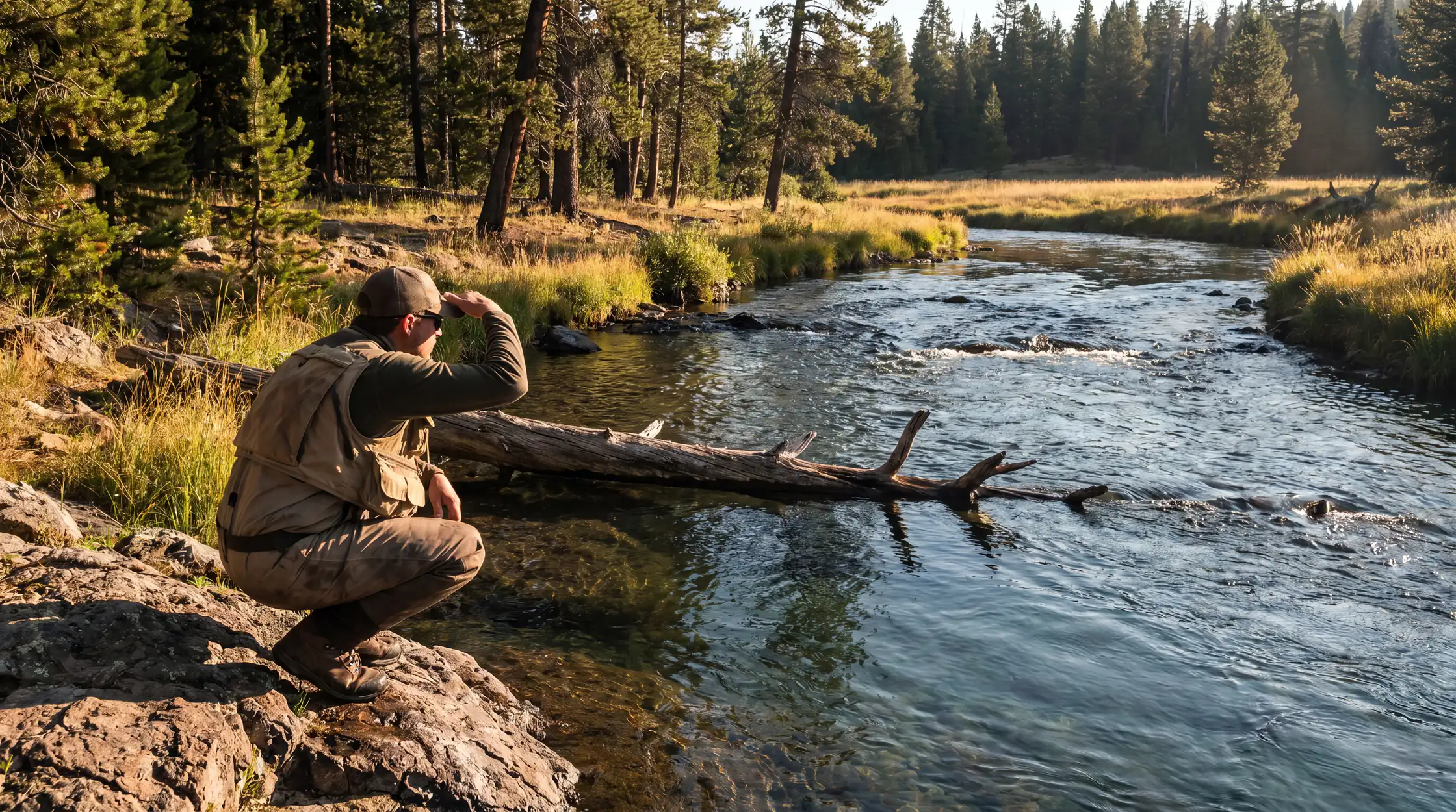
The Discipline of Slow Looking
On busy public water there is a temptation to cover ground. You move because someone else might be in the run you would have fished, because the fish that are willing have probably been bothered, because you have driven a long way and want to feel like you are working. On private water, especially the small spring creeks and meadow streams that make up much of the private inventory in the American West, that instinct is wrong. The fish are still there. The pressure is low. The water is quiet. What separates a productive day from a frustrating one is rarely speed. It is attention.
The most useful skill on private water is the discipline of slow looking. Walk to the edge of the bank. Crouch if the bank is high enough that your shape breaks the skyline. Spend three full minutes on a single forty-foot section of river before you make a cast. Watch the surface. Watch the way the current breaks around structure. Watch for the small disturbance that a feeding trout makes — the boil that almost isn't a boil, the dimple that lasts a quarter second, the brief shadow that crosses a light-colored patch of gravel and then disappears.
Most of what you need to read a stream is already in front of you. The trick is to look at it long enough to see it.
The Three Forces
A trout in moving water is solving three problems at the same time. It needs to be where food is delivered. It needs to hold somewhere that does not cost more energy than the food provides. And it needs to be close enough to cover that a heron, an osprey, or a streamer-throwing angler does not become a survival event. Almost every productive lie on a small stream sits at the intersection of those three forces.
The place where food is delivered is usually the seam. A seam is the line where two currents of different speeds meet — the edge of the main current where it brushes a slack-water pocket, the inside line of a bend where fast water peels away from a soft trough, the tail of a riffle where the faster broken water flattens into a slick. Food tumbles through the fast lane. Trout sit in the slow lane and pick what they want.
The place where they can hold without burning calories is almost always behind structure — a submerged rock, a fallen log, a clay shelf, an undercut bank, a depression in the streambed that creates a cushion of dead water in front of it. Current piles up on the upstream face and slides around the sides. The trout sits in the calm pocket and watches the seam.
The place where they feel safe is whatever makes a kingfisher's job harder. Deep water. Heavy cover. The dark slot under a log jam. The shadow line two feet inside an undercut. On hot, bright days the safety variable dominates. On overcast mornings the trout will move out from cover and feed in water you couldn't have approached the day before.
Most of the lies people miss are missed because they are obvious on one of the three variables and quietly excellent on all three. The seam looks plain. The structure is submerged and invisible from the bank. The cover is two feet downstream of where you stopped looking.
What the Obvious Water Teaches
The head of a pool, the white tongue at the top of a run, the dark center of a deep pocket — these are the places everyone fishes. On private water they are still worth a cast, but they teach you something else: they are easy to read. The current is loud, the structure is visible, the cover is obvious. You don't need to spend long there.
The water that teaches more is the in-between water. The shallow flat above a riffle that looks too thin to hold anything until you watch it for two minutes and see three rises in the same lane. The slow, glassy tail of a pool where the water seems to stop moving until you realize the trout there are sipping spent caddis off the surface in a feeding line so narrow it takes a four-foot leader extension to fish without dragging. The cut against the willow bank where the bank itself is the cover and the structure is the undercut you can't see.
These are the lies that pay back the time you spend learning to see them. They are also the lies that nobody fishes on public water because they are not worth the time when you are competing with twelve other anglers. On private water, with the quiet and the access and the lack of pressure, they are exactly the lies you should be looking for.
The Bank You're Standing On
The single best place to fish a small stream is the one nobody can see from the bank you're standing on. The trout knows the predators come from above and from upstream. It positions itself to watch the upstream lane, to use cover against birds, and to rely on the current itself to mask sound from above.
Which means: the prime lie is almost never directly in front of you. It is forty-five degrees upstream and slightly across, where a slow seam slides past a piece of structure you have to walk fifteen feet to see. It is the inside of the bend behind you. It is the slot under the willow on your own bank, which means you have to wade across the river to fish your own side properly.
Good anglers on private water spend almost as much time walking as casting. They cross. They double back. They climb the bank to look from above. They take the long way around. The lie is not where you arrive. The lie is where you can present a fly without putting yourself in the trout's window.
What the Hatch Is Telling You
A hatch is not just a feeding event. It is a map. The flies coming off tell you where the current speed and substrate are exactly right for those nymphs to emerge. The risers tell you which lanes the trout have chosen as feeding stations. The seam where the rises are dense is telling you something about the food delivery in that exact corridor of the stream.
If you watch a hatch for ten minutes before you wade in, you have a free read of the productive water for the next two hours. You can see which seams the fish are using. You can see how aggressive they are on the surface. You can see whether they are working close to the bank or out in the middle. The rises tell you what the current is doing under the surface.
This is the kind of intelligence that separates a competent angler from a deadly one. The competent angler ties on the right pattern and starts casting. The deadly angler ties on the right pattern, watches for ten minutes, and then casts to the exact lie that has been making fish all morning.
On Private Water, Time Is the Resource
Most of what differentiates a private water day from a public water day is what you do with time. On public water, time is the constraint — every minute you spend looking is a minute someone else is casting. On private water you are usually alone, or sharing the river with one or two other rods you can coordinate with. The constraint shifts. Time is not scarce. Attention is.
The practical implication is that you can afford to fish slowly. You can sit on the bank for ten minutes and watch a piece of water before you cast. You can change the leader, change the fly, change the angle, and try the lie a second time. You can climb the bank to look from above and decide where you are wading next. You can spend two hours on three hundred yards of water and leave knowing you have actually seen it.
The anglers who get the most out of private water are not the ones who cover the most ground. They are the ones who notice the most things. The lie under the third willow on the inside bend. The dark shadow that moves a foot upstream when a cloud passes over. The seam that holds a fish at nine in the morning, an empty current at noon, and a different fish in the same exact lane by four o'clock.
Reading water is a discipline. On private water, it is the discipline that pays back the most. The fish are there. The pressure is not. The work is to look long enough to see what is happening, and to put the fly in the lane where something is already eating.