Why Insurance Is the Quiet Center of the Model
If you ask a landowner who has never participated in a structured private water program what their biggest concern would be, almost every answer comes back to the same word. Liability. The fear is real and reasonable. Strangers are walking onto private property, into moving water, in waders, with hooks. Even with careful anglers, the irreducible risk of slips, falls, and equipment injuries is non-trivial. The fear of being sued — and the corresponding fear of an insurance carrier raising rates or dropping coverage on the underlying property — is the single most common reason landowners decline to participate in fishing access at all.
The answer to that fear is not reassurance. It is structural insurance design. The reason the modern private water access model works is that the liability exposure is not sitting on the landowner. It is sitting on the club, the platform, and the angler — in layers, with redundancy, in a way that turns the landowner into the protected party rather than the exposed one.
This is the layer most anglers never think about. It is also the layer that, more than any other, distinguishes a serious private water program from a casual handshake arrangement that will eventually fail.
What the Club Carries
A serious fly fishing club operating on private water carries a general liability insurance policy. The policy is real — typically with a major commercial carrier, with limits that match the scale of the activity, and with specific endorsements that cover the operations the club actually runs.
The critical mechanic is the additional-insured endorsement. When the club takes a landowner onto its insurance, the landowner is named on the policy. This means that if an angler is injured on the property and tries to recover against the landowner, the club's insurance — not the landowner's — is what responds. The landowner's policy is not touched. Their carrier is not notified. Their rates are not affected.
This is the practical translation of "transferring the risk." The landowner has given the club permission to operate on their land. The club has, in exchange, taken financial responsibility for any liability arising from that operation. The landowner remains the owner of the land. They do not become the insurer of the angler.
Good clubs treat this coverage as non-negotiable. The premium is part of the cost of operations. The certificate of insurance gets renewed annually. The landowners on the property each receive a current certificate showing they are named. None of this is exotic. It is just the standard architecture of operating responsibly.
What the Angler Signs
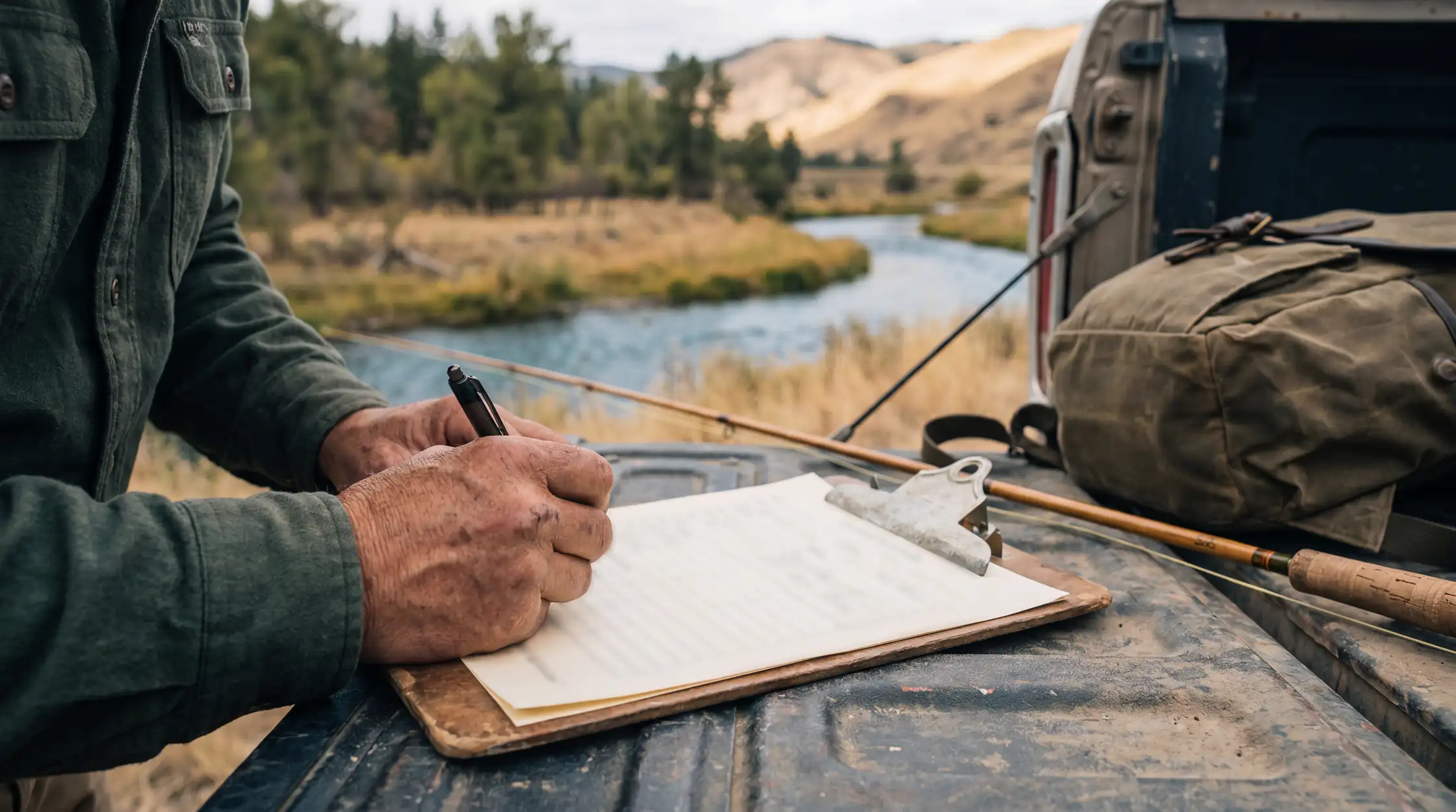
The second layer is the angler waiver. Before any angler steps onto a property, they sign a document acknowledging that fly fishing involves inherent risk — slips, falls, drowning, hypothermia, hook injuries, lightning, wildlife encounters — and that they are participating with full understanding of those risks.
The waiver does not absolve a property owner or club of negligence. A landowner who left a clearly dangerous obstacle in a path, or a club that failed to communicate a serious weather hazard, can still face claims for negligence. What the waiver does is shift the baseline. The angler has been informed. They have acknowledged. They have accepted the ordinary risks of the activity. The conversation about responsibility starts from a different place than it would if no waiver existed.
The better systems handle waivers digitally and route them automatically. A booking made on a property triggers a waiver requirement. The angler signs once per season or once per property, depending on the program. The signed waiver is timestamped, stored, and retrievable by the club and the landowner if it ever becomes relevant. Nothing about this is intrusive to the angler. It is the same waiver they have signed at every guided trip they have ever taken, with the structure to actually use it if needed.
What the Landowner Should Verify
A landowner who is considering opening their water to a club has a short list of things to verify. The list is not complicated, but it is important.
First, the certificate of insurance — current, naming the landowner as an additional insured, with limits appropriate to the activity. The landowner should hold the certificate, not just hear that one exists. The certificate should be from a carrier the landowner can look up.
Second, the waiver process — a clear understanding of how anglers are required to acknowledge risk before they arrive, how the waivers are stored, and how the club handles incident reporting if something happens. A club that cannot answer these questions clearly is not operating at the standard the model requires.
Third, the club's incident history — not because incidents disqualify a club, but because a club that has handled previous incidents professionally is a club that knows how to handle the next one. Ask the question directly. Listen to the answer.
Landowners who do this verification are not being paranoid. They are doing the same due diligence they would do for any other professional service operating on their land. The clubs that take it seriously appreciate the question and answer it cleanly. The ones that don't are the ones the landowner does not want as a partner.
What Happens After an Incident
Incidents happen on rivers. An angler slips on wet rocks. A wader rip lets in cold water. A hook ends up in a thumb. Most of these events are minor and resolved at the moment. Some are serious and require a response.
The well-designed system has a clear protocol. The angler reports the incident — through the platform, through the club, or directly to the landowner. The club's insurance is notified if there is any chance of a claim. Documentation is created at the time of the event, not reconstructed later. The landowner is informed but not asked to manage the response. The handling is professional and prompt.
The reason this matters is that it is the test of the entire structure. A landowner who participates in a program and then experiences an incident handled poorly is unlikely to participate again. A landowner who experiences an incident handled the way it should be — quickly, transparently, with the club's insurance responding as expected — gets the assurance that the structure works as advertised.
This is, again, the difference between an arrangement with serious infrastructure underneath and an arrangement that looks the same on the surface but does not hold up under stress.
What the Platform Adds
The modern platform layer adds verification and visibility. The platform confirms that participating clubs carry current insurance. It tracks waiver completions. It surfaces certificates to landowners on demand. It maintains the audit trail of who was on what property when, which becomes essential if an incident requires reconstruction.
None of this is glamorous. It is back-office work. But it is the reason that a landowner participating in a network can verify the insurance structure of every club on their property without making phone calls. It is the reason an angler can sign a single waiver and have it work across the network. It is the reason that the trust-based system underneath private water access can scale beyond the individual handshake.
Why This Matters for the Long Run
The insurance layer is what makes private water access a sustainable business rather than a personal favor. It is what allows landowners to open their water to people they have never met, with confidence that the financial exposure has been transferred to parties who have agreed to carry it. It is what allows clubs to operate at scale without each transaction being a one-off liability negotiation. It is what allows the angler to fish a property they have never been to before, knowing the structure underneath is real.
Without this layer, the model does not function. With it, the model can grow.
For anglers, the insurance infrastructure is invisible most of the time. It is the small box you check during a booking. It is the waiver you sign once a season. It is something you only think about when something goes wrong — and when something goes wrong, it is the reason the situation is resolved without anyone losing the access that made the day possible in the first place.