When Browns Become Hunters
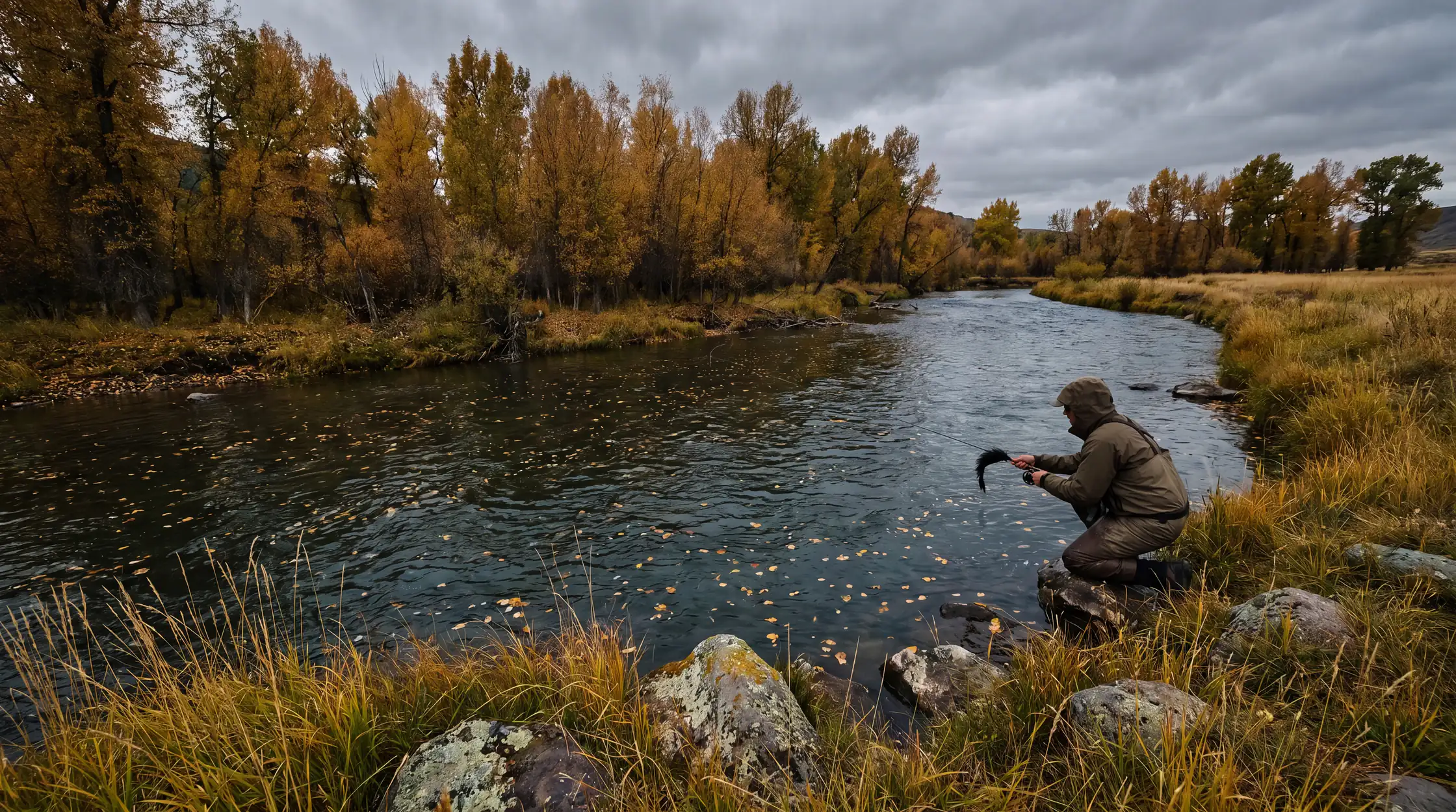
If you fish only one season on private water in your life, fall is the right one. The summer pressure has eased. The mid-July temperatures are gone. The water is dropping into the fifties on the freestones and the spring creeks are at their fall steady. And brown trout — which spent the summer holding deep, eating drifting nymphs and the occasional terrestrial — begin to act like the apex predators they always have been.
The shift is not subtle. A brown trout that has spent three months sitting in a deep slot at the bottom of a pool, eating size 16 mayflies one at a time, is suddenly moving. It starts hunting the seams. It chases sculpins out of riffles. It takes positions in the kind of shallow tail water it would never have held in August. By the third week of September in most western systems and the first week of October in the East, the largest browns in the river are visible in ways they were not visible all summer.
This is the window streamer fishing was built for. And on private water — quiet, uncrowded, and structurally suited to the kind of slow methodical fishing streamers require — it is the time of year when the system pays back everything it asks of you the rest of the year.
What Streamer Fishing Asks of Water
Streamer fishing is not a casual pursuit. Done well it requires a specific kind of water and a specific kind of approach. You are not fishing fast. You are not covering a lot of ground per hour. You are working a piece of holding water carefully, presenting a fly that imitates a baitfish or a leech in a way that triggers a predatory response, and giving the fish time to commit.
This kind of fishing requires three things that are difficult to come by on busy public water. It requires room — enough open run that you can fish the seam, the bank, and the slot below the structure without colliding with another angler. It requires quiet — the fish you are trying to catch are sensitive to noise, motion, and pressure, and a stretch of water that has been fished by three boats already that morning is unlikely to produce. And it requires time — the cast, the retrieve, the change of angle, the re-cast, the slower retrieve, the pause, the strip-strike. A single seam can take twenty minutes to fish properly. On a guided drift boat covering ten miles of water in a day, that twenty minutes is a luxury nobody has.
Private water provides exactly these conditions. The capacity is set by the property. The pressure is what the calendar allows. The day is yours to spend on a thousand yards of river, working it methodically. This is the kind of fishing the property is designed for. Streamer anglers know this and book accordingly.
Why Fall Works the Way It Does
The biological reason fall works is straightforward. Brown trout are fall spawners. The pre-spawn period is when they put on weight, defend territory, and move to the gravel runs where they will eventually reproduce. During this period they are more aggressive than at any other time of year. They are also more visible, more concentrated in particular kinds of water, and more willing to commit to a streamer that intrudes on their territory.
Water temperatures in the high forties to mid-fifties are the strike zone. Higher than that and the fish are still in summer behavior. Lower than that and metabolism slows enough that they will not chase. Most western systems hit this zone between mid-September and mid-November. Eastern systems run a few weeks behind. Knowing your watershed's fall temperature curve is how you time the window.
Light matters too. Streamer fishing favors overcast days, low-angle morning light, and the long shadow hour before sunset. On a bright high-pressure day in October, the same fish that smashed a streamer at first light will refuse it at noon. The good private water days during this window are the cool, gray, drizzly ones that send fair-weather anglers home and leave the river to the people who came to fish.
The Private Water Advantage
The advantage of private water in fall is not subtle. It is structural.
On public water in October, you are competing with everyone else who knows fall is the season. The famous tailwaters are crowded. The known streamer runs have been fished hard. The largest browns in any given system are wary by the second week of the season, and you are unlikely to see them eat anything you did not present in the first thirty minutes of light.
On private water in October, you have the run. You can spend forty-five minutes on a hundred yards. You can change flies, change angles, fish a single seam at three different depths, walk up to a different beat, and come back to the original spot in the afternoon when the light has changed. The fish you are trying to catch is the same fish that was there at dawn. Nobody has spooked it in the intervening six hours. Your second pass with a different fly is a real second pass, not a pass through water that has been disturbed all morning.
This is how the largest fish in a private water system get caught. Not by force. By patience that the structure of the property makes possible.
Reading Fall Holding Water
Fall lies are different from summer lies. The browns that spent August in the deep slots are now in the slower water adjacent to the runs. They sit in the soft water below a riffle, where baitfish get pushed out of the fast water and have to recover before swimming back up. They take positions in the heads of pools, where structure and current converge. They move into the tails of pools at low light, when the shallow water is safer and the bait is more available.
The willow banks become important. The undercuts hold fish that would not have used them in August. The slot between two pieces of structure becomes a hunting lane. A piece of water that looked unproductive at a summer hatch can hold a four-pound brown in October because the calculus has changed for the fish.
The practical implication for the angler is that you should fish more of the water than you did in summer. The lies are not where they were. Spend time looking at the soft water. Fish the seam adjacent to the bank, not just the seam down the middle. Work the tails of pools at first and last light. Walk slowly. Watch for the wake.
How to Approach a Fall Day
A productive fall day on private water is not a marathon. It is a series of patient half-hours. Arrive with conditions in mind — temperature, light, recent weather. Pick a stretch and commit to it for the morning. Work the seams methodically. Change flies more often than you would in summer, because the fish are responding to motion and silhouette in ways that nymph fishing doesn't ask of you. Take breaks. Watch the water.
The best fall days are not the ones with the most casts. They are the ones with the right casts. A single thirty-foot strip across the head of a pool, at the right speed, at the right time of day, can produce the fish of the year. That fish exists because the water is private, the property is quiet, the calendar gave you the run to yourself, and the conditions held.
This is what fall on private water is for. The summer made the fish. The system protected the water. The fall lets you find them. Take the time. Fish the slow seams. Watch for the wake. The browns are out there, and they are hunting.